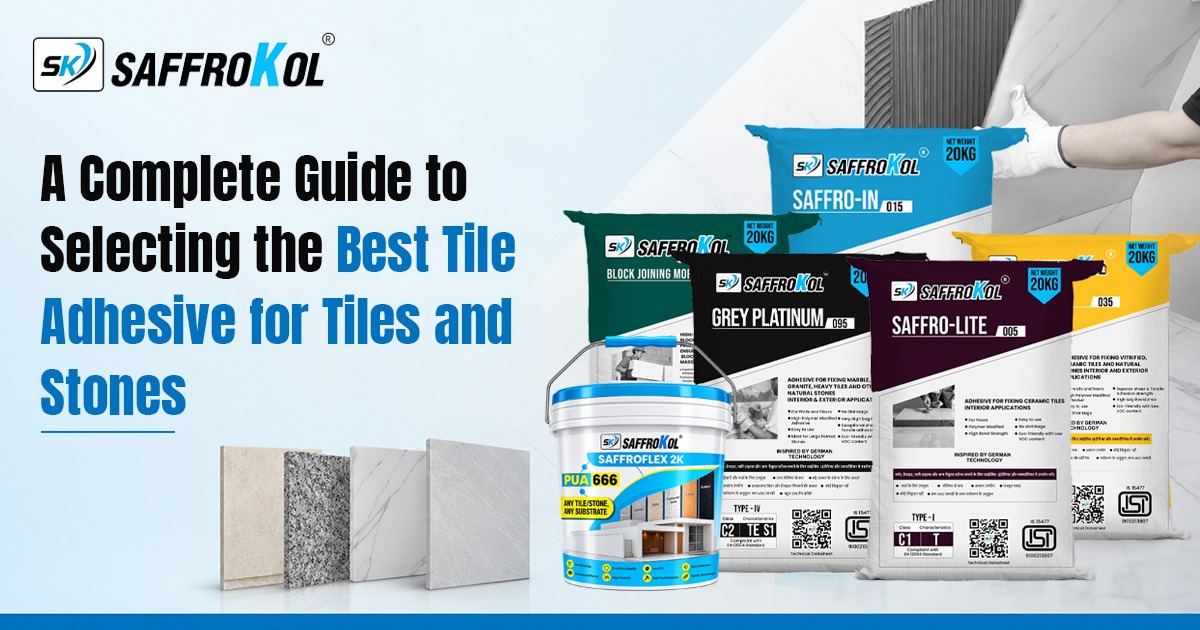
Tile Installation is incomplete without the selection of an effective Tile Adhesive. From ceramic tiles for the living room floor to vitrified tiles for commercial use and natural stone in an open environment, the adhesive plays a major role in making the installation strong and durable.
Cement-sand mortar is slowly losing its popularity for bonding because of its inability to bond with modern day denser, bigger and low porosity tiles. An excellent adhesive will ensure that you have a strong bond along with added flexibility, water and temperature resistance. The selection of the correct type of tile adhesive helps in ensuring a perfectly installed tile installation.
Modern day construction industry prefers tile adhesives as compared to any other material for bonding. Not only do they provide quality installation but also take care of maintenance issues later. Be it for flooring purposes or cladding purposes or for heavy duty natural stone installation, selecting the correct tile adhesive can make a difference between success and failure of your project.
In this guide, we will discuss various types of tile adhesives available in the market, their advantages, uses and how a dependable Tile Adhesive Selector can help you in choosing the best one for your installation project.
What Is Tile Adhesive?
Tile adhesive refers to an engineered adhesive which fixes tiles and stones to different surfaces including floors and walls. Different from traditional mortar, current day tile adhesive consists of polymers and additives which enhance its performance in terms of better adhesion and flexibility.
Current day tile adhesives are made keeping in mind the requirements of modern times whereby installation of large-sized tiles and low porous materials demands stronger and more reliable bonding system. They can be easily applied and ensure consistent performance.
Table of Contents
Tile adhesives are used for:
- Ceramic tiles
- Porcelain tiles
- Vitrified tiles
- Glass mosaics
- Marble and granite
- Natural stone applications
- Tile-on-tile applications
Reasons Why Modern Building Is Choosing Tile Adhesive
The construction industry has gone into the adoption of tile adhesive due to the following benefits associated with it as compared to cement mortar.
-
Stronger Bond
It is a fact that tile adhesives provide a better bonding strength compared to the surface they are bonded with; thus, it guarantees that the tiles will not come off easily. This is very important when it comes to larger-sized tiles as well as heavy stone installations.
-
Quick Installation Process
Tile adhesives are thin as compared to cement mortar, meaning that one can install tiles quickly while ensuring high-quality installation. This increases productivity, and at the same time, saves the labor costs.
-
Flexibility
Polymer-modified adhesives can easily resist any movement of tiles due to structural and thermal expansion of the structure. Hence, they are used to cover any small movements in the building.
-
Minimal Material Wastage
Tile adhesives are easy to use and easy to prepare. Therefore, one is able to apply the minimum amount of material as compared to cement mortars.
-
Long Life Performance
One of the greatest benefits that tile adhesives have is their capability to perform better in bonding for many years. Proper installation of tiles with quality adhesive will make it last for long years without breaking.
Types of Tile Adhesives
-
Cement-Based Tile Adhesive
Cement-based tile adhesive is by far the most popular type of adhesive used in construction work both at home and office. It is available in powdered form and needs to be mixed with water before use.
Used for:
- Ceramic tiles
- Floor tiles
- Interior walls
- Home projects
Advantages:
- Low cost
- Easy to apply
- Good bonding properties
- For all general applications of tiles
Cement-based adhesives are best suited for common installations and require good bonding properties.
-
Polymer Modified Tile Adhesive
This adhesive is made up of modern polymers which give an increased performance in terms of flexibility and strength of bonding.
Suitable For:
- Porcelain Tiles
- Vitrified Tiles
- Big Size Tiles
- High Traffic Zones
- External Use
Advantages:
- Increased Flexibility
- Water Resistance
- Bonding Strength
- Resistance to Cracks
These types of adhesives are highly recommended for use in the current tile laying processes.
-
Epoxy Tile Adhesive
There are two types of components in epoxy adhesives, which include the resin and hardener, resulting in an incredibly strong and durable bond.
Recommended for:
- Industrial settings
- Commercial kitchens
- Labs
- Swimming pools
- Robust applications
Advantages:
- Superior bonding capacity
- Waterproof properties
- Resistance to chemicals
- Durability
In most cases, the epoxy adhesives are viewed as the best adhesives for tough jobs where regular adhesives cannot be utilized effectively.
-
Ready-Mixed Tile Adhesive
These readymade adhesives have been mixed in advance and do not need mixing before use.
Good For:
- Mini home renovations
- DIY works
- Interior wall tiles
Advantages:
- Ease of application
- There is no mixing needed
- Time saving
- Quality consistency
Such adhesives are very handy when fast repairs are necessary and for small-scale domestic works.
-
Stone Adhesive
In addition to this, there is the Stone Adhesive which is created for the purpose of binding natural stones such as marble, granite, sandstone, and engineered stones.
Best For:
- Use in marble constructions
- Installation of granite stone cladding
- Stone facades
- Natural stone flooring
Benefits:
- Excellent carrying capacity
- Strong bonding with both the surface and the stone
- Minimum chances of staining
- Increased durability
Due to the fact that natural stones are heavier than ceramic tiles, the application of stone adhesive will guarantee safety.
Common Mistakes to be Made While Selecting Tile Adhesive
Failure in many cases is attributed to wrong choice of adhesive used.
The following mistakes are often made:
- Application of general purpose adhesive to big size tiles
- Use of normal tile adhesive to fix stones
- Disregard of requirement of exposure to moisture
- Choice of adhesive depending only on its cost
- Putting down adhesive on inappropriate surface
Another common mistake is that the suitability of the surface for the application is disregarded. Even if the best adhesive is selected, the performance of the latter would be unsatisfactory if put on dusty, uneven and unstable surface.
Thus appropriate surface preparation and adhesive selection is crucial.
Why Choose a Tile Adhesive Selector?
A Tile Adhesive Selector is a great solution to make the right decision based on the following factors:
- Type of tiles
- Size of tiles
- Substrate material
- Whether indoor or outdoor installation
- Exposure to moisture
- Technical demands of stone or tile installation
Choosing a tile adhesive selector allows getting rid of uncertainty and making sure that the selected product will be able to meet all the technical demands of the installation. This is how time can be saved and quality improved.
With a tile adhesive selector, one does not have to deal with guesswork anymore.
Conclusion
The selection of the right bonding agent is essential for the proper fixing of the tiles. Regardless whether it concerns simple ceramic tiles or high-quality stone installations, each job needs its bonding material. Getting familiar with the different kinds of Tile Adhesive and Stone Adhesive allows for creating durable installations which require less effort during maintenance and service.
Having taken into account the type of tiles used, location of installation, conditions of the substrate and exposure to moisture, the choice of an appropriate bonding material will be much more efficient. Spending money on the proper bonding material pays off because the right adhesive will guarantee safety and quality of the installation and its good condition for many years.